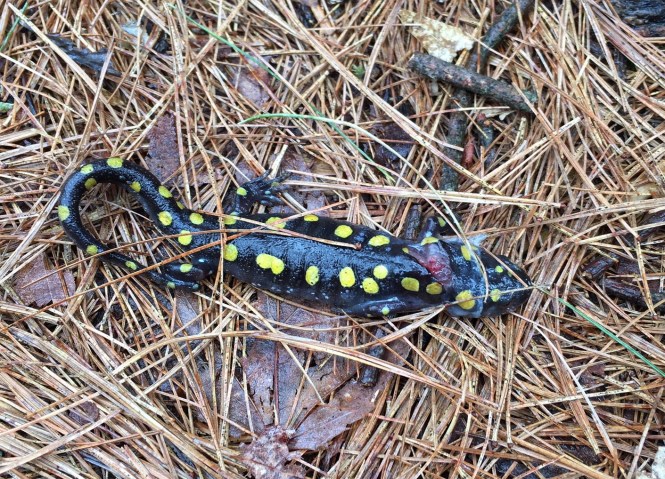
Yellow Spotted Salamander

yellow spotted salamander

He was dead when we got there. Or she. It’s hard to know for sure with amphibians. What was clear is that someone had stepped on this yellow spotted salamander right in the middle of the trail. Possibly that little critter was lured out of the mud a few days earlier by more spring like conditions. Some shoots had emerged. Peepers sang in their swamp, but the day I saw my first yellow spotted salamander was chill with misty rain. The peepers silently waited, likely in stillness. Because that’s the thing about amphibians and reptiles – they are only as warm as the world around them. They cannot generate their own heat, and they rely on the heat of the sun to awaken, kindle, move, and live.

Our small group – two adults and two kids – had ventured out just to enjoy the woods. We had no plans for a long journey and we took our time at the edge of the beaver pond. Then, set back from the edge of the pond, on the woody side of the hummock where we had watched the birds, we found a vernal pool. A large disc of white ice floated on its surface obscuring any signs of life. We did startle one frog whose sluggish response was a full three seconds after it should have been. Chilled froggy synapses.

I imagine the salamander had emerged from the vernal pool. Slowly. One step at a time. Waking up in body and mind and with each moment of sunlight, coming back to an awareness of life and what it means to live for a salamander. This was not his/her first spring. When I found it, I called everyone back to admire its beautiful markings and some people expressed dismay that they had been the ones to tread on it. Maybe. It could be that it had been there for hours.

After a time, the group – meaning the kids – started to move on, but I wanted to linger. I didn’t want to leave this beautiful broken body on the trail in case someone else came along and stepped on it again. I felt sadness that for lack of warmth, this salamander had been caught in the most mundane of traps, lying motionless in plain, not seen by its crusher. On the other hand, I did not want to toss it unceremoniously into the bushes and covering its beautiful skin with dirt seemed very wrong.

Ultimately, I left the salamander right there in the trail. I realized that as I gazed at its beautiful markings I found myself smiling just to know that such a beautiful creature exists right here in my town. I decided that maybe someone else would, like me, feel thankful for that opportunity to see that these amphibians grow big, and wander freely across the forest floor. Part of me hopes that in fact the little bloody spot on its back was just an abrasion and that when the weather warmed up the next day, the salamander was able to regain the use of its legs and slip back into the vernal pool. More likely, if slightly less optimistic, a happy raccoon came upon it and was able to provide a good meal to her family.

In the end, I am amazed that finding a dead amphibian gave me so much to be thankful for. Beautiful creatures, protected habitat, trails, and friends to walk with. We stood in awe over this little body and felt thankful for what it showed us of the world around us. We felt warmth in our shared appreciation of its life. It’s taken me years to even see a dead yellow spotted salamander in the wild, and while I hope I never see one like this again, I am thankful for the moment we had.
Restoration Takes Vision

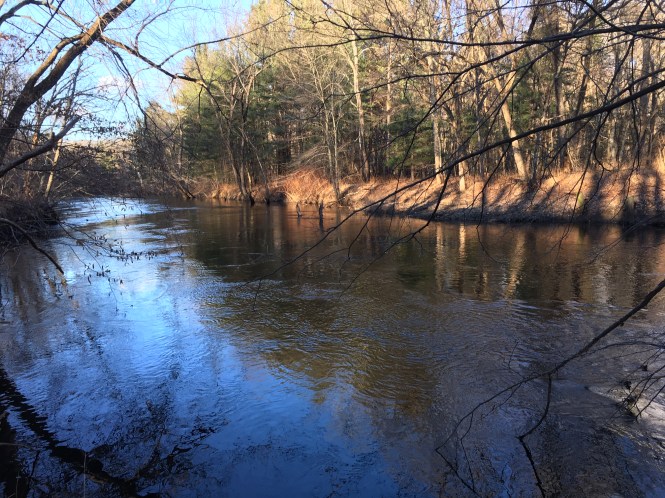
Nashua River from Esker Trail

In early March, my beautiful little church home was broken into and vandalized. The culprits took their time. They dismantled our soaring eagle lectern and broke our audio system. Candles were left burning down to nothing in their stands, and oil was spread all over the floor and altar. They left their mark on all of our most sacred places, including burns in the floor and chips in the prim wooden box where we store the wine and bread. The simple cross that stands on top of that box now bends back towards the organist while he plays. In short, they went after the light, the word, and our spiritual food. Among our many reactions and feelings, we know enough to be thankful that it was not a lot worse.

In the days that followed, we worked hard to make things right. We cleaned and repaired and secured. The efforts of many hands made a difference. On Sunday morning, we reopened our doors, re-consecrated our sacred space, and had our service. As we sang hymns and passed the peace, I was aware that while we had restored order and cleanliness, we had not gone back to the way things were. The damage is permanent, and it cannot be hidden, nor should it be. The damage to our church has a purpose. One, it serves to remind us both of the distress we felt on having our sacred space defiled, and of the love that surged from our local communities in response. Two, when we encounter a sacred place that is damaged and desecrated, we are called to see past that – to remember that it remains beautiful and that we must restore it to wholeness.

This ability to see the possibility of restoration – to envision the return to beauty – applies in the natural world where human activity has left an ugly mark. Consider the Nashua River. Once amongst the most polluted rivers in the United States, this river was restored through the work of multiple communities, under the leadership of Marion Stoddard, who refused to accept that it was beyond repair. She recently spoke at a forum in Fitchburg, MA where paper mills created the many-colored waters that flowed through towns like Ayer and Groton. During the forum the facilitator asked people to share their stories of the river and several lifelong residents of Fitchburg stood up each expressing the same sense of distance, even revulsion. One said that as a child and young adult, she never thought of the river as a river – it was nothing but stinking muck. Another person said that he had no interest in the river as a young man because he simply did not believe that it could be better. It was beyond hope, so why spend time and money on a lost cause? They had turned their back on the damaged river and the worse it got, the further they distanced themselves from its presence in their town.

We then heard about the amazing 50 years of the Nashua River Watershed Association (NRWA) and the Nashua’s even more amazing designation earlier this year as a Wild and Scenic River. This federal status is ascribed to rivers of national importance in terms of culture, beauty, and wildness for the sake of present and future generations. In short, in only 50 years, the Nashua River has been restored from a 34-mile-long filthy dumping ground to a beautiful natural and recreational resource, and all because Marion Stoddard saw beyond the damage. She believed in restoration.

The Wild and Scenic Nashua River tells us that stories of restoration require stories of human transformation – of changing one’s mind and heart. Marion described the greatest challenge of her work was not in removing the source of the pollution or cleaning out the solid waste or even working with the State House, but in restoring people’s vision of the river as a place as a source of beauty, recreation, and life. Her vision included not just clean waters, but greenways so that people could have a direct relationship with the river – so they would not turn away. In changing the hearts of the people who lived along its banks, she taught them the value of the river, that it’s worth paying for restoration, and to ask for what you want, not what you are willing to settle for. Today, people live, work, and recreate along the river, and celebrate the greenway as a city landmark.

Even with all its beauty, the Nashua River will always bear witness to its difficult and damaged past. The people who love the Nashua today, including the people who fought for its Wild and Scenic status know they cannot reverse or eliminate the evidence of what the river has suffered. Permanent structures including dams and factory ruins tell the story of what it went through, what it had to survive, and how much work went into the change. Just as my church now has burns in the floor, these reminders have work to do. They remind us that new threats continue to impact the river including invasive species, nonpoint source pollution, and an increasingly ‘indoors’ generation. We still have work to do to change hearts and minds.

Additionally, rivers like the Nashua, and other stories of restoration inspire us to re-visit our perceptions of our role when we see damage in the natural world. How do we feel when a pregnant whale starves to death because her stomach is full of plastic? Does it change how we treat single use plastics? What is our call to action when increasingly strong storms impact people who are already vulnerable? Can we answer the call to climate action? Reversing the impacts of human industrialization is a big job, changing the way of the world takes faith in the future, vision and hope and people who will step forward to make real changes.

Marion saw and smelled muck, and believed in a clean flowing, swimmable, wild and scenic river. Marion knows that the ecosystems we live in need love, light, sustenance and our presence. Restoration does not just show the resiliency of nature, but the strength of the human mind and spirit to change the way we do things for current and future generations.

Quoted at the National Wild and Scenic River page (www.rivers.gov)

In the past 50 years, we have learned—all too slowly, I think—to prize and protect God’s precious gifts. Because we have, our own children and grandchildren will come to know and come to love the great forests and the wild rivers that we have protected and left to them . . . An unspoiled river is a very rare thing in this Nation today. Their flow and vitality have been harnessed by dams and too often they have been turned into open sewers by communities and by industries. It makes us all very fearful that all rivers will go this way unless somebody acts now to try to balance our river development.
– President Lyndon Johnson on signing the Wild & Scenic Rivers Act, October 2, 1968. (quoted at https://www.rivers.gov)


Rejoice! Reduce! Renew! A Lenten Program for Creation Care #LoveThyPlanet

Cowdry March 2019When I started attending St. Andrew’s Ayer 20 years ago, I sat way in the back, hoping no one would notice me. Now I sing in choir, serve on Buildings and Grounds, and from time to time come up with elaborate programs designed to push people from apathy to action on climate change.
This year, that takes the shape of a Lenten Creation Care program, an idea that came to me all in one moment during a meeting of the Creation Care Justice taskforce in the Episcopal Diocese of Massachusetts. During that meeting, I realized that Easter falls on the eve of Earth Day, and I thought to myself, ‘what can we do with that?’ The answer was the Rejoice! Reduce! Renew! program that is described at StAndrewsAyer.org/CreationCare. My hope is that by entering into Lenten practices and talking about our call to love our neighbors and care for our world, we as people of faith can lead on climate action from a place of joy and hope. I hope we learn that action on climate change is just another way for us to shine God’s love into the world.

I believe that love is fed by a love of the natural world, and yet people increasingly separate themselves from the nature, particularly in the winter. We huddle indoors, and hustle from our homes to our cars to another indoor place. With that in mind, several of the practices recommended during lent involve time outside. First is a daily observance of just going outside to listen, feel, smell, and observe nature. The special silence of a snowy morning, over 40 days will become the welling birdsong of spring. The sting of morning frost will melt into the damp soils and wakening bulbs of daffodils and crocus. We will also have a series of hikes on Sunday afternoons for us to spend time together in community with nature. Time outdoors stirs the sense and awakens our wonder and awe. Exploring our oneness with the Earth’s vitality reinforces our connection to nature and to one another.

And of course, action on climate change does require some measure of knowledge especially given the campaign of misinformation and doubt circulated by high profile, influential people. On our first Sunday Adult Forum we talked about the definition of global warming and how the ‘warming’ at the atmospheric level causes changes in our local climates. We talked about how climate change means just that – change. Change means something different from what we expect and that can be warming or cooling – it could mean more precipitation or less precipitation. We also talked about how weather – what is happening now outside – cannot be equated with climate – what we expect based on data over an extended period of time (20-30 years). In short, a person who looks out the window and claims that a snow storm today disproves global warming has not grasped the basics and should be encouraged to read well-sourced information. We do not need to become experts in climate science, but we should challenge ourselves to know the basics, so we can make decisions based on the best information. I recommend that people who feel daunted visit their local libraries and take our books on climate change from the children’s library.

During our Adult Forum, we named some of the impacts of climate change from rising seas, to increases in insect borne illnesses, interruptions in food supply, water shortages, and loss of home and lives to extreme weather. We looked at models of future changes in climate based on whether or not we can reduce our carbon emissions finishing on a slide that showed model flooding for downtown Boston. All very sobering.

And, we paused to assess where we are right now and think about what we really need to know about climate change:

It’s Real
It’s Us
Scientists Agree
It’s bad
There’s hope*

And, here’s the thing. I have given presentations about climate change for ten years. A lot has changed in that time, but what I believe today is this. People of faith – from all traditions – must speak out to inspire action on climate change because people of faith are called to be people of hope. We are not called to despair. We sing our praises to God and with God’s help we persist.

People of faith are called to show God’s love for the world in the way they live their lives. We need to make the everyday actions we can take for climate change mainstream. Get a home energy audit, insist on reusable bags, advocate for and use public transit, support renewable energy development, divest from fossil fuels companies, communicate with your elected leaders about the urgency of action on climate change for people of faith. Tell them where you stand. The more they hear from their constituents the better.

I was inspired by the people who attended the presentation on that first Sunday in Lent. I was encouraged. The more I think about it, the more I see how people of faith can make a real difference in climate action. I hope that these Lenten practices become lifelong habits that we share with our friends, families, in our neighborhoods, at work, and across the world!

Amen!

On Pilgrims

For most of my life, I’ve had a perfectly workable and simplistic understanding of pilgrims. As is typical for most kids who grow up in the public schools of Massachusetts, we learned about the people who left England on a life-threatening journey to the new world so that they could practice their religion away from the persecution of the Crown. They were portrayed as brave. I am sure that Mr. Green would be proud to know what I remember from his classes at Central Junior High.

The thing about those Pilgrims is that they must have been more than brave. It takes more than bravery to up and move your family on a dangerous journey to an unknown land. Many people died and yet, so many people followed them. I cannot relate. While I am fascinated by their decision to take the trip, I have never thought about how they got to that decision. It’s outside my frame of reference. Frankly, if you had asked me two years ago if I knew anyone who had taken a pilgrimage I would have said no with confidence. I mean, who does that these days?

Always with me, what I have yet to learn.

It turns out that a lot of people venture out on these purposeful journeys. Of course, I know about pilgrimages to Mecca. I have heard that people visit places that mean something to them, or more often than not that they hope will mean something. Either way, the idea of modern pilgrimage seemed quaint and distant, even dusty to me, until I heard a call of my own.

I should come clean. I go to church regularly. I work within the local Episcopal Diocese on matters relating to caring for the Earth including Climate Change action. But, these are practical activities that take place from the home base. As a full time working parent, I do not have time to take meaningful or even meaningless journeys with unspecific goals, and certainly not without the entourage of children, spouse, and canine that comprise my usual away-team.

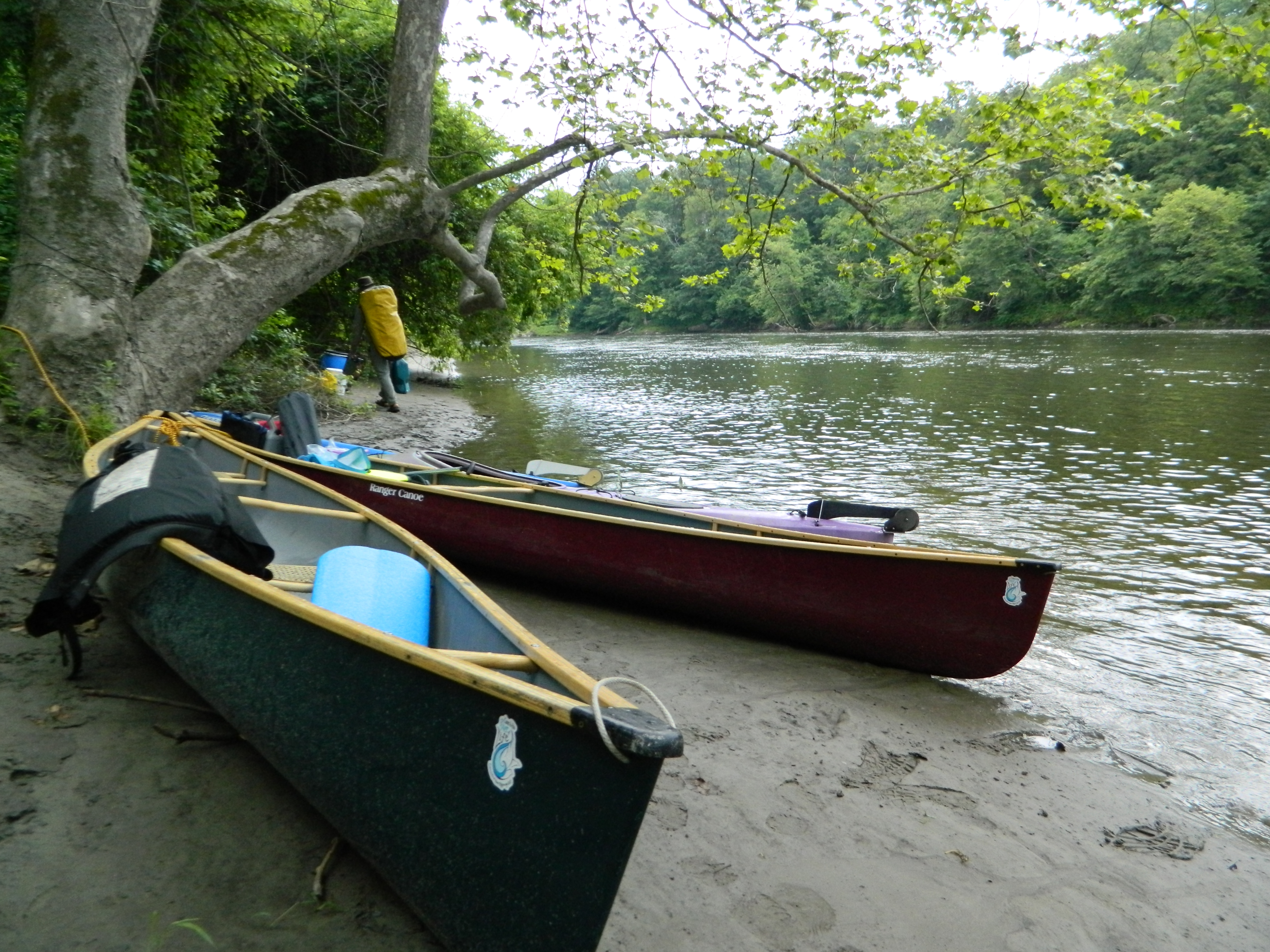
Then, I had this moment of invitation. A group I worked with was planning a 40-day pilgrimage on the Connecticut River. A lengthy paddling trip where all the folks involved would be seeking a spiritual connection through an experience with nature. I mean, I know it’s a mouthful, but more importantly, I knew I wanted to be there even though I could really not say why.

It is not within the scope of this post to talk about that trip in its entirety. I do hope to pull forward elements of that experience in future posts, but for now, I want to talk about that moment of assent. That moment where a ludicrous, impossible idea becomes not only possible, but something I could not say no to. Sensible, stay-at-home me found herself applying for a period of leave from work, and taking on the various preparations that go into a 2-week paddling trip that is infused with prayer and wonder and silence.

In that moment of assent, I was conscious that these moments get rarer as I get older. Most of my moments these days are more about the kids or about what’s right for the family, than they are about me as a person, as an individual. It’s easy to lose track of that inner voice when you spend a lot of time managing schedules for kids, co-workers, projects, volunteer hours, etc. It’s easy to ‘get to it later’ when it comes to exploring big questions about if and how God fits into my life. It’s easier not to know frankly. I mean, once you know, how can you ignore God? I am guessing that’s not a thing.

Ironically, what made me say yes to this journey was fear. I was afraid that I was starting to get a bit fearful, motionless. That I was losing any sense or capacity to change and grow. I can see now that I was more afraid of not going than I was of going. And, of course, once I decided to go, I spent the next several months resisting the whole thing, but that’s another story.

What I want to say here today is that becoming a pilgrim was the last thing on my life plan. Agreeing to a journey with people I don’t know to unfamiliar places changed my understanding of what makes someone a pilgrim in the first place. They are not looking to escape, they are answering a call – a beckoning. It’s an inward journey right out with the world. Pilgrims are specifically not expecting to gain anything tangible from the experience. It’s the intangible they seek. Whether or not they travel across any vast geography, they experience movement.  And it has to start from a moment of assent. A moment where asking ‘what’s the worst that could happen?’ is answered with, ‘nothing’.

Three years ago…

Three years ago, I sat down and wrote a disjointed message that was trying to reflect the experience of several people. It’s not great. Since then, I have composed many additional posts in my mind, all very fascinating and humorous, but when it came to it, I didn’t get it done. Today, I am giving it another try.


Most of the time, I write in another voice – an organizational voice. I don’t mind, but I find that I need an outlet for the things that are not ‘on message’. Like, I might say that taking risks while you are outside can be a good choice. For example, on one hike I led with a group we passed the edge of what had become a frozen wetland. The trees with high osprey nests, the beaver lodge and the distant shore beckoned – awakening my curiosity. But I did not lead the group onto the ice. It’s not what they signed up for. Back in the parking lot, the kids asked me why I had turned us back, and I explained that it was too dangerous for me to take the group out there, but that I would bring them back. One of them pressed me, ‘It’s too dangerous for them, but not for your kids?’ Exactly.

When I brought them back, we spent hours exploring little islands and coves that we could only reach by walking on water. We put our faces onto the ice to see the trapped air bubbles. We tried to see the water through the cracks in the surface and looked at each other in wonder as we listened to the ice freeze and move around us. Dangerous? Maybe. Totally memorable and worth the risk? Yes.

So, I want to try to use this space for these kinds of ruminations. Maybe no one will ever come here, but I want to write and I want to share. Recently, I discovered that while what I say and believe may not fit well in one place or another, I am a perfect fit right here where I am. OutdoorFaithS. That’s me.


Have you ever taken a risk outside that was totally worth it?